Thursday, January 6, 2022

Has SF hit rock bottom? Former mayor says city's 'humanitarian' ethic is to blame for recent issues

Featured in ABC7 News:

SAN FRANCISCO (KGO) -- Former San Francisco Mayor Willie Brown isn't sugar coating his assessment of San Francisco these days.

"It looks pretty bad there is no way to hide it," Brown said in an interview with ABC7 News contributor Phil Matier Tuesday.

The former mayor is speaking about the impact of high visibility crimes, the ever-present homeless problem, and the drug-addicted or mentally ill people are having on a city once known for both its tolerance and beauty.

"When you walk in certain parts of the city, you can't even walk on the sidewalk without getting permission from the people who control the sidewalk. And they are the allegedly the homeless," Brown said.

Never one to shy away from controversy, Brown lays much of the blame on the city's overly "humanitarian" ethic.

"Anything you do in this town with reference to the homeless is a political risk," Brown says. "Why? It's simple. San Francisco has a reputation for being so humane. And there are so many organizations and individuals who want to display that. They don't want you and they don't want San Francisco accused of not being humane."

Matier: "So what you're saying is that at the heart of the problem is that when it comes to the homeless and drug-addicted, San Francisco offers an array of carrots but it refuses to pick up any kind of stick?"
Brown: "No question because, you see, once you want to help the homeless, sometimes homeless don't want to be helped. And if you don't have any legal way in which to force it upon them, you got a real problem."

Brown says the only elected leader at City Hall trying to make a change is Mayor London Breed, who is drawing heavy criticism from homeless advocates for bringing in police as well as social and medical workers to deal with the problem

On the other hand, Brown says the residents of the city are fed up with the situation.

One reason for the change in heart is the images of robberies, open drug dealing, and drug use they are seeing on TV.

And that ongoing coverage is "in fact, what caused, in my opinion, the mayor's reaction," and her police crackdown in the Tenderloin, Brown says.

"No politician would move, simply because I have no reason to. Period," Brown says.

But, "I think London Breed is genuinely committed to the idea that we ought to make San Francisco for everybody," Brown said.

Whether the city's legendary "humanitarian" voters will back Mayor Breed has yet to be tested.

"When it comes to voting or going or getting involved, they say 'I know I want it to be humane. I don't want it to be I don't want people having the choice between rehabilitation and jail," said Brown.

It's a political Catch-22 that has residents demanding a clean-up but unwilling to back the mayor when she pulls out the broom.

Meanwhile Brown says if residents don't see and feel a change on the streets then every elected official - especially the mayor - will be in peril.

"They'll elect somebody else. And if she doesn't succeed, it'll be trouble. It'll be trouble," said Brown.


Multiple suspects have been arrested after a Louis Vuitton store in San Francisco was hit by thieves.


Monday, December 27, 2021

Happy Belated Christmas and Stepping Up in 2022

From all of us at SF CARES, we hope everyone had a happy Christmas with good food, great company and a bucket full of love to give and receive. As we venture into an uncharted 2022 that is riddled with uncertainty, instability and more questions than answers, we turn to our Creator for guidance. All we can hope to be is better than we were in 2021, be kinder, to help those less fortunate and to never (physically and metaphorically) walk around or over the homeless as if they don't exist. It's the easiest act of humanity to give the poverty half your sandwich, pop into a store and buy them an energy bar or just look them in the eye and say hello, with sincerity. There are so many complex reasons why someone is homeless and it's not our job to judge them with the most obvious conclusion. It's our job to only look down when we're helping someone up, as this could give them the drive to change their life path for the better.

Finally, please start your new year on the right note by paying forward through signing up to volunteer for a couple of hours. Even if that's just once a month, you'll have given 24 hours worth of your time to help someone else. Here are some websites you can volunteer, today, and leap into 2022 with the most ethical foot stepping forward. Guaranteed, it'll be your best one yet.

https://www.mobilize.us/togethersf/   

https://www.handsonbayarea.org/calendar 

https://www.volunteermatch.org/

https://www.sfmfoodbank.org/

Blessings!


Monday, December 20, 2021

Seeing Signs of Speculation, SF Allocates Millions to Buy Housing

Featured in the San Francisco Public Press:
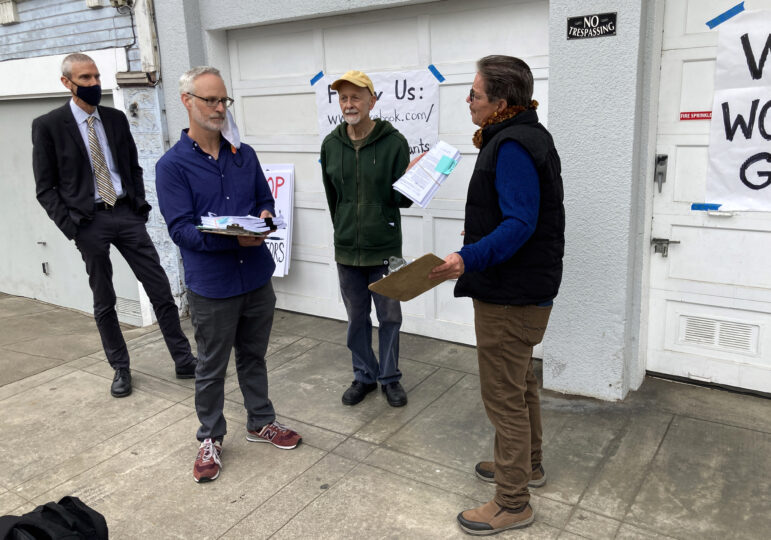
Amplified chants and drumming broke the weekday calm on 19th Street near Dolores Park in mid-November as residents of a 12-unit building protested their impending eviction.  

“Here in this building, six out of the 10 units that are occupied have LGBTQ tenants, five out of the 10 have Asian Americans. And we have seniors in this building who have been here for decades. And we’re all getting evicted,” said Paul Mooney, a gay man who has lived in the building for 18 years and came to San Francisco because of its LGBTQ community.  

Tenants, advocates and city legislators are worried about real estate investors buying multi-unit housing properties like this one only to evict all of the tenants and sell the buildings for a profit. They have called for an end to the state law that makes this possible, the Ellis Act, under which the tenants on 19th Street are being evicted. In the meantime, they want the city and the nonprofits it works with to buy those buildings instead of leaving them for speculators to snap up.   

“The Ellis Act is devastating neighborhoods like ours, communities like ours,” Mooney said. “There’s 20 of us that are at risk of losing our home from this neighborhood that we’ve lived in for so long. And it’s happening all over the city, because of the Ellis Act.” 

But the state Legislature is unlikely to repeal the Ellis Act, one local legislator acknowledged.  

“I think everybody here wants to see the Ellis Act repealed. And we all know that real estate and real estate money has tremendous power and influence in Sacramento,” said District 8 Supervisor Rafael Mandelman at the demonstration.  

In the meantime, however, local government can step in. Last week, the Board of Supervisors voted to allocate $64 million of revenue brought in by the 2020 real estate transfer tax measure Proposition I to an emergency fund for housing acquisition. Supervisor Dean Preston, who proposed the allocation, said there are signs that speculation is threatening many apartment buildings in the city, and that the allocation could help combat that. 

“Preliminary analysis of market trends shows exactly what we fear: A repeat of trends we saw a decade ago,” Preston told the board. “Of 117 buildings between three and 50 units on the private market, 99 of the sellers are individual or families with no connections to big real estate, in contrast to the folks who are lining up to buy these buildings.” 

He said members of the city’s Housing Stability Fund Oversight Committee have been keeping a close eye on the buyers of multiunit properties that go on the market and finding that many are limited liability corporations linked to large corporate real estate investment companies. 

A program called the Small Sites Acquisition Program already exists. Nonprofit landlords and the city collaborate to acquire housing, keep the tenants in place and keep rents below market rate. The city also has the Community Right to Purchase Act, which gives nonprofit organizations the right to make offers on buildings with three or more housing units, or lots that could accommodate such units, before other buyers.       

Some of the supervisors expressed concern that the Small Sites Program is not ready for an acquisition spree and needs serious reform.  

“Promising folks that we’re going to save them from eviction because we’re putting money into this program that is not currently viable, to me is an empty promise,” said Supervisor Myrna Melgar. While she supports funding the acquisition of apartment buildings, she said, “It is like putting gas in a car that has two flat tires and is in the shop getting fixed, and promising people a ride.” 

Most of the acquisitions executed so far through the program have been made by one nonprofit that is overextended and has taken on excessive financial risk, she said. Other supervisors criticized the program for not preserving enough housing. Since the program was launched in 2014, it has acquired 368 units across 47 buildings. 

Mayor London Breed also voiced opposition to the allocation, announcing in a press release that her office would be taking steps to reform the Small Sites Program and allocating up to $10 million from the city’s general fund through June 2022. While the supervisors ultimately voted 8-3 to allocate the $64 million to allow the city to buy housing through any of its acquisition programs, the mayor is not obligated to spend that money and several supervisors expressed doubt that she would. The mayor’s press office did not respond to a request for comment on her intentions. 

Preston, for his part, is optimistic.  

“These funds are going to be appropriated, they’re going to be available,” he said. And the investment is a significant one in terms of how many people could remain housed if their buildings are acquired by a nonprofit.  

“We are looking at hundreds of units,” he said. “It will depend on the exact purchase price of each of those, and the size of the different buildings. But it’ll be hundreds of units and at least double or triple that in amount of people protected.” 


A process server delivers the court documents to Paul Mooney initiating his and other tenants’ eviction under the Ellis Act from a 12-unit building on 19th Street. 

(The above is a segment from SF Public Press's radio show and podcast, “Civic.” Listen daily at 8 a.m. and 6 p.m. on 102.5 FM in San Francisco, and subscribe on Apple, Google, Spotify or Stitcher.) 


Monday, December 13, 2021

Project Open Hand Food Available

Megan Sue Belafonte and Project Open Hand (POH) are giving away food boxes that they receive on Mon. and Fri. mornings at the corner of Folsom and 22nd St. You need to get in line by 10am to get a ticket for a box of food. Then at 11am you may pick up your box. This is a POH program and there is usually milk, two types of protein, lots of vegetables, rice, beans and sometimes even eggs.


POH usually do not do this on days like holidays or the Friday after a holiday (such as Thanksgiving). Sometimes they skip a week so it's best you check with them to see when their next food giveaway is. (415) 447-2300 and https://www.openhand.org/

If you or someone you know can use this service, please do let people know. Please also share this since this catastrophic rise in inflation is crippling people's ability to buy basic food.


Tuesday, December 7, 2021

Should California have a $18 minimum wage? Voters may get to decide

Featured in the LA Times:


California voters could get to decide whether the state minimum wage goes up to $18 an hour, at a time when rising prices and living costs are eating into workers’ household incomes.

Joe Sanberg, a Los Angeles investor and anti-poverty activist, spearheaded the Living Wage Act of 2022, which was filed with the state attorney general’s office Friday. Sanberg said he will finance the signature-gathering process to qualify the ballot initiative for the November election. It would gradually increase the state minimum wage starting in 2023, then rise to $18 an hour for all-sized businesses by 2026.

The current minimum wage is due to reach $15 an hour for large businesses starting in January, and for all businesses by 2023. The state minimum is now $14 an hour for businesses with 26 or more employees and $13 an hour for smaller businesses.

“If you work full time, you should be able to live with full financial security, and that’s not the case in California,” Sanberg said in an interview. “We were a leader in pushing for a $15 minimum wage, but now we have to move the ball forward and farther. It’s overdue for $18.”

He said the time is right to push for a higher minimum wage because the pandemic highlighted how many Californians working full-time jobs still cannot afford basic needs.

Sanberg made his fortune on Wall Street and then shifted to investing in start-ups, including meal-prep company Blue Apron.

He is well-known in Sacramento, having cajoled legislators beginning in 2015 to create a California version of the earned income tax credit — a program that has been expanded in recent years to help more low-income residents. He founded a nonprofit to launch an advertising campaign to make sure eligible people got their money.

He’s also a co-founder of Aspiration, an online banking service that allows customers to choose their own fees.

Although it’s rare for wealthy Californians to personally bankroll all costs involved in an initiative signature campaign, it has happened occasionally through the years.

And under state election law, Sanberg could stop there — choosing to withdraw his proposal once it qualifies for the ballot if lawmakers and Gov. Gavin Newsom agree next year to pass a similar law on their own.

The initiative would mandate that base pay at businesses with 26 or more employees go up a dollar each year until it reaches $18 an hour in 2025. Smaller businesses with 25 or fewer employees will have an extra year to reach the $18 minimum.

After reaching $18 an hour, the minimum wage will be adjusted yearly to keep pace with the cost of living, according to the initiative.

California’s current gradual rise to $15 an hour was the result of a bill signed in 2016 by then-California Gov. Jerry Brown. The law, which went into effect in 2017, raised the minimum wage steadily each year to reach $15 an hour. In 2016, the minimum wage for all businesses was $10.

The rise to a $15 hourly wage has had a “real, measurable effect on workers’ pay in the state,” said Ken Jacobs, chair of the UC Berkeley Labor Center. The center has estimated that 5.6 million Californians would receive a wage increase because of the move to $15 an hour, with an average annual earnings increase per person of $3,700.

By the time the minimum wage reaches $15 an hour, it will equal a total of more than $20 billion a year in wage increases, which is more than the combined value of all the state’s major public assistance programs, Jacobs said.

Still, “it was still an important increase but ... costs have continued to rise,” he said. “It’s also important to note that, especially with rising housing costs in California, that in our major cities, $15 is still not enough.”

Advocacy group United Ways of California calculated that a family of four — two adults, one preschooler and one school-aged child — living in Los Angeles County would need to make an annual income of $95,112 to meet basic needs. That calculation, known as the Real Cost Measure, is based on publicly available data on expenses such as housing, food, healthcare and child care.

California’s high cost of living is a main reason why Sanberg and others are advocating for an $18 an hour minimum wage.

The minimum wage should now be $24, if it increased in line with the growth in worker productivity since 1960, Sanberg said.

The fact that the state base pay is one year away from $15 an hour “doesn’t mean it’s the right minimum wage,” he said. “The job will be done when everyone who works full time can afford life’s basic needs.”

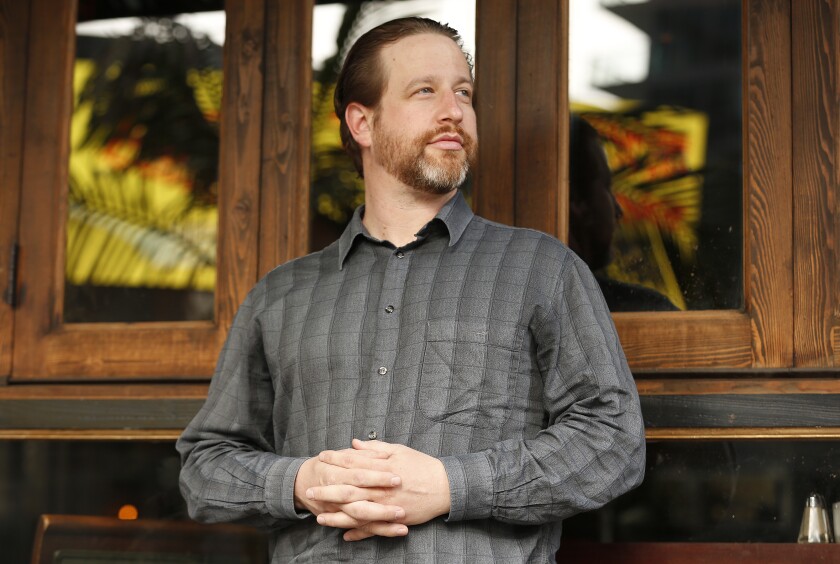
A man in a black striped shirt stands in front of a doorway. 

Joe Sanberg, a millionaire investor and anti-poverty activist, is financing the signature-gathering process for a ballot measure to raise California’s minimum wage. (Al Seib / Los Angeles Times)


Tuesday, November 30, 2021

Proposed Tenant-Organizing Protections Could Shift Balance of Power in SF

Featured in the San Francisco Public Press:


Credit: Noah Arroyo/San Francisco Public Press

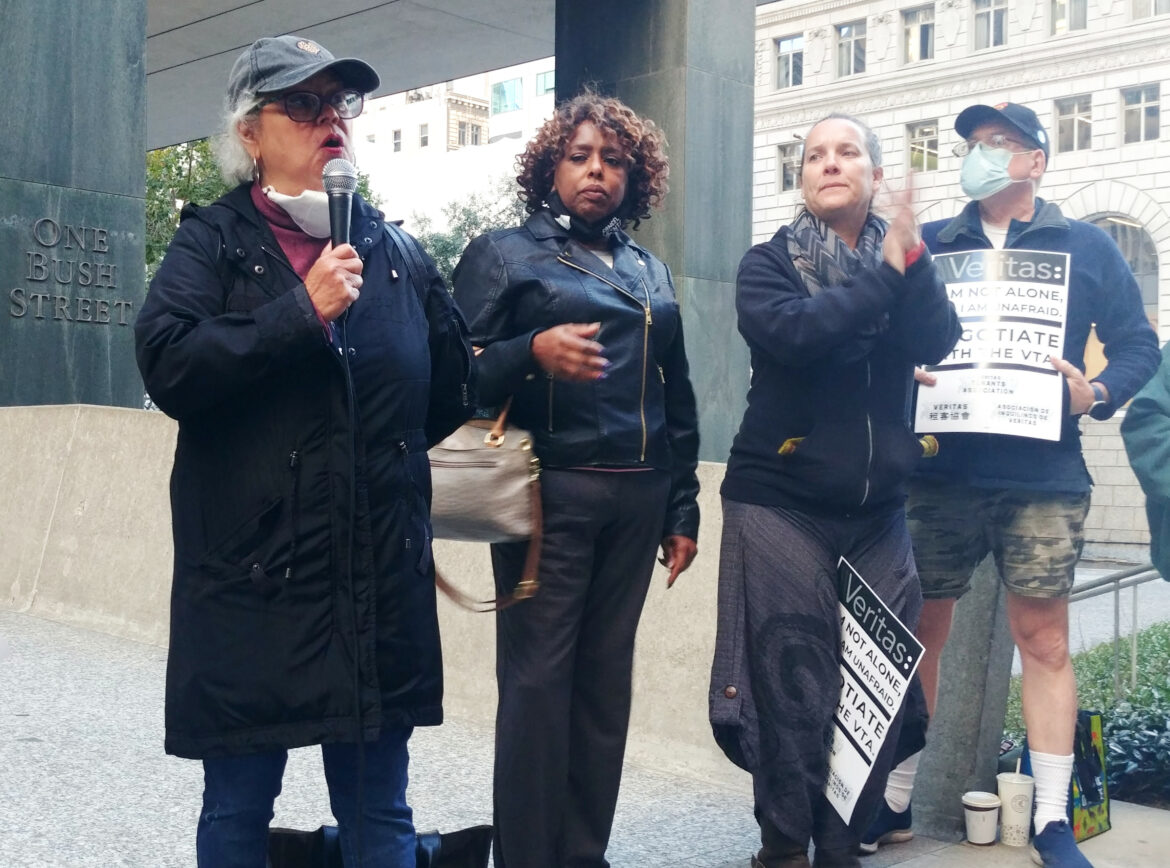
The Veritas Tenants Association has been trying for more than a year to get Veritas, often called San Francisco’s largest landlord, to negotiate a rent-relief package for tenants who faced COVID-19 financial hardships. Debbie Nunez, left, and other association members assembled outside the company’s headquarters in October to draw attention to the impasse, which pending local legislation could resolve.


Renters throughout San Francisco could gain power to lessen COVID-19 financial hardships and improve conditions in their buildings with political-organizing tools that have a history of success in subsidized housing.

In coming weeks, city supervisors will weigh legislation that would make it easier for tenants to form associations, similar to labor unions, that could compel landlords to hear them out on a range of issues, including the aesthetics of new construction and other matters affecting the bottom line for owners.

The proposal, authored by Supervisor Aaron Peskin, is inspired by protections that tenants in federally assisted housing secured 20 years ago — and might be the first legislation in the nation requiring private landlords to sit down and bargain.

The San Francisco Apartment Association, a property-owners group with thousands of members, opposes the legislation.

This is “all about power,” said Brad Hirn, a tenant organizer with the Housing Rights Committee of San Francisco, one of about a dozen tenant and labor groups that collaborated with Peskin and his staff as they crafted the legislation. “Power comes from organized people. And the legislation creates a tangible reason to organize,” Hirn said.

A lone tenant may have limited ability to persuade a bad or neglectful landlord to take requests seriously, and might back down in response to scare tactics like eviction threats. A group of tenants could be harder to frighten or ignore.

A response to landlords who stymie organizing efforts

Peskin’s legislation would explicitly protect San Francisco renters’ efforts to form tenant associations, which would be officially recognized for a building if the residents of at least half the units signed on. Upon the association’s request, landlords would have to meet at least once every three months and confer “in good faith” about tenants’ concerns. The legislation gives examples of good-faith interactions, such as “responding to reasonable requests for information” and “negotiating and putting agreements into writing.”

The requirement to meet and confer is “groundbreaking,” said Fred Sherburn-Zimmer, executive director of the Housing Rights Committee. “We have asked tenant groups around the country. If there is a law that requires this, we have never heard of it.”

If the law were in place and landlords did not follow the rules requiring meetings, the city’s Rent Board could penalize them by forcing a drop in rents. Landlords would not be punished for refusing an association’s demands.

The legislation’s real strength would be in enabling and possibly normalizing tenant organizing, Sherburn-Zimmer said. An organized group might more effectively employ strategies — such as drawing press attention, protesting publicly or even withholding rent — to compel a landlord to make concessions.

Tenants can already politically organize, but sometimes landlords try to stop them, Sherburn-Zimmer said. She recalled an instance when long-time San Francisco tenants asked for her help brainstorming a response to impending rent hikes, which would force some to move out.

“We tried to have a meeting in the lobby, and the landlord sent someone to disrupt it, then tried to physically throw me out,” Sherburn-Zimmer said. The group relocated to a cafe, where they settled on a request.

“They were like, ‘you bought this building, we know you can raise the rent as much as you want. Can we at least negotiate the amount of time we get before the rent increase?’” she said, adding that they requested reimbursements for relocation costs. The mayor’s office interceded, and in the end, the landlord gave tenants some of what they wanted.

“It was imperfect, but it was a sign that this could be helpful in all kinds of situations,” Sherburn-Zimmer said, referring to collective bargaining with government oversight.

Veritas, generally called San Francisco’s largest landlord, has also tried to reduce interactions between tenants and the Housing Rights Committee, Hirn said, which has hurt organizing efforts.

In early 2020, 76 Veritas buildings were up for sale. Hirn began visiting them, knocking on doors to educate tenants about their rights and what to expect in the months to come. The Veritas Tenants Association was knocking too, welcoming tenants to join and sign a petition stating a desire to bargain with the company over the terms of the sale. Veritas then sent tenants a memo asserting that state law limited visitors to speaking only with the residents who invited them. The company warned that, in response to violators, it would call the police “to protect the security of the building and residents.” It made good on that threat.

But that’s just one interpretation of state law. By another, a visiting tenant organizer should be able to speak with anyone in the building, said Brian Brophy, a tenant attorney at the law firm Tobener Ravenscroft LLP.

“Because a court has not interpreted that specific question,” Brophy said in an email, “and because there are landlords/property management companies challenging knocking on doors, there is potential legal risk” to the tenant organizer.

If passed, Peskin’s legislation would clarify that visiting organizers could talk to anyone in the building.

Veritas declined to comment for this story. However, spokesman Ron Heckmann asserted that the company does not own or act as landlord for its buildings. Rather, it “manages apartment assets on behalf of owners and investors,” he said.

The company has not divulged its full portfolio of properties, which are rent-controlled and legally owned by various limited-liability companies and similar entities. Separately, Veritas created the company GreenTree, which manages conditions and tenant concerns in the buildings.

A boon for the Veritas Tenants Association

Peskin’s proposal is in large part a response to the experiences of the Veritas Tenants Association, which has over 1,200 members who live in more than 100 Veritas properties in San Francisco, as well as in buildings in other cities, Hirn said. The association, which was involved in discussions over crafting the legislation, has tried for more than a year to get the company to negotiate on multiple demands that would address tenants’ financial hardships during the pandemic.

In an attempt to draw Veritas to the bargaining table, more than 50 of the association’s member households have committed through November to withhold their applications to the state to cover their rent debt — a combined $5.7 million that would go to Veritas — a move that makes them vulnerable to eviction.

They will soon vote on whether to continue their “debt strike” through December, Hirn said. Any delay in applying with the state could reduce their odds of getting rent assistance, as the programs have already received more requests than currently allocated funds can satisfy

The association wants to negotiate a rent-relief package with the company for all members who need help.

For tenants who took on debt to cover rent during the pandemic, the association wants temporary rent reductions to help people pay off their credit cards, payday loans or debts to family or friends, since rent-relief programs will not help with this secondary debt, often called “shadow debt.” Members also want the company to never apply the rent increases for 2020 and 2021 that it has so far delayed — that includes the annual increases that the Rent Board allows, to follow regional inflation, and “passthroughs” that reimburse the landlord for construction costs and other expenses.

If Peskin’s legislation passes, it could give Veritas’ tenants, and those of other landlords, the tools to pull them to the bargaining table.

“I think it makes sense, it’s reasonable, it’s overdue,” said Debbie Nunez, a member of the Veritas Tenants Association. “I anticipate some pushback form Veritas. That’s just part and parcel with what they do.”

Associations could be useful in less contentious settings too, said Lee Hepner, legislative aide to Peskin and lead staffer on the tenant-association proposal.

“I’d like to think this is a tool for building community among a group of tenants,” Hepner said.

A tenant association could weigh in on safety considerations, use of common areas, laundry-room restrictions and, most importantly, construction schedules. Hepner said his office has repeatedly heard complaints from constituents that working from home was difficult because “in the middle of the workday, water and electricity would shut off without any warning.” Peskin passed emergency legislation early in the pandemic to prohibit certain utility and water shut-offs.

Associations might also distill the varied concerns of the entire group into talking points, similar to the way neighborhood organizations represent residents’ concerns in conversations with Peskin’s office, Hepner said.

“At the risk of sounding naive or like I’m gaslighting landlords, this could make their jobs easier,” Hepner said.

‘A solution in search of a problem’

Not everyone is excited about the proposal.

Requests like those from the Veritas Tenants Association are best decided between the landlord and specific tenants, rather than with an entire building’s occupants, said Charley Goss, government and community affairs manager for the San Francisco Apartment Association.

That would be especially true if the landlord were helping tenants with shadow debt, Goss said, which might be owed to institutions or to personal contacts without documentation.

“It’s hard to sort of verify the need in an objective way. There has to be a sort of needs demonstration, which by definition is particular to the circumstances of that one individual,” Goss said. “You’re basically looking at a set of factors: medical, child-care expenses, rent rates, even their history as a tenant.”

He was also skeptical that tenants would collectively be able to agree on their requests of the landlord, especially regarding construction issues.

“One person wants the wall patched, but the other one wants to work in peace,” Goss said. If major construction were on the table, then “maybe the tenant in Unit 1 is having a kid next month, and they’d like it pushed off for a year if possible.”

But Goss’ main criticism was that the legislation seemed unnecessary.

“We’re having this conversation like all tenants are underserved, unprotected, low-income and being snubbed by their landlords. If you take a step back, I don’t think that anyone thinks that’s the case,” he said. In response to tenant hardships last year, between 21% and 54% of landlords reported granting rent reductions each month, according to surveys by the Apartment Association.

The Apartment Association is in contact with Peskin’s office to try to “improve the legislation and make it more workable and productive,” Goss said.

Andrew Zacks, a real estate attorney in San Francisco, called the legislation “a solution in search of a problem.” In an email, he said it “implicates the landlord’s 1st amendment rights” to the extent it punishes their refusal to engage in negotiations.

Real estate attorney Daniel Bornstein said he’s concerned that landlords will get treated unfairly when tenants appeal to the Rent Board, which will have to weigh in on new aspects of the tenant-landlord relationship.

“It’s one thing to make an assessment of whether there was heat in the building,” Bornstein said. “It’s another to make an assessment of whether there were good-faith meetings. That’s fraught with a lot of what might be circumstantial, and not very apparent.”

“What is ‘good faith?’” he said, and questioned whether a landlord would be violating the law by merely walking out of a conversation that became unruly.

Peskin has vetted the legislation with the City Attorney’s Office. And Hepner said Rent Board leadership has assured him that they could handle this new extended oversight role.

As for the assertion that the legislation is unnecessary, Hepner said, “I don’t think anybody can say with a straight face that there aren’t tenants that have been aggrieved and wouldn’t benefit from a seat at the table when communicating with landlords.”

The Board of Supervisors’ Rules Committee will review the legislation before the end of the year, Hepner said. Peskin is on the committee, and one of its two other members, Supervisor Connie Chan, has co-sponsored the legislation, making its progression to the full board all but certain.

‘Right to organize’ in public housing paved the way

The legislation is heavily inspired by similar protections created in 2000 for housing that is privately owned and subsidized by the U.S. Department of Housing and Urban Development, and in which about 1.3 million households live nationwide.

Those rules, collectively called the right to organize, were “a sea change” for tenants, said Michael Kane, executive director of the National Alliance of HUD Tenants, which fought for the protections.

Kane started organizing in the 1970s and encountered many tactics from landlords who neglected and sometimes preyed upon their tenants.

“Owners demanding sexual favors of women, vulnerable women, in order to get an apartment. Very common,” Kane recalled. When tenants tried to politically organize, he said, owners threatened them with eviction, or offered bribes to a tenant leader to induce them to step down and destabilize their group. He said they also sent spies to tenant meetings to undermine them and gather information.

Tenants gaining the right to organize shifted the balance of power. It explicitly protected efforts to meet and form groups for collectively dealing with owners and landlords. Professional organizers and tenant advocates were also protected if they came onsite to talk to people and distribute flyers.

“I heard stories of people getting harassed, and they would take the regulations to the property manager, who would back off,” Kane said.

It was a success story for tenants in most cases, though Kane called it “insufficient” because of a lack of enforcement by HUD.

After reviewing Peskin’s legislation, Kane said it would be “very exciting to have a right to organize in private housing generally, beyond HUD subsidized housing.”

He said that, if the law were passed, tenants of landlords with multiple properties might gain bargaining leverage by uniting across buildings.

“That could be very powerful. And everybody will see that. So tenants will have a very strong incentive to join, and nowadays with social media it would be possible to do that,” Kane said. “It will be a blossoming of tenant organizing across the city.”

Wednesday, November 17, 2021

Former Haight Street McDonald’s lot stirs homeless debate

Featured in the San Francisco Examiner:

Rarely has an unused parking lot raised such rancor.

Once the site of a notoriously seedy McDonald’s — known more for its violence and drug deals than its hamburgers and fries — 730 Stanyan has sat chain linked and vacant since The City purchased the lot for $15.5 million in 2018 and razed the building.

The site is slated to become an eight-story apartment complex with the bulk of the 150 units reserved for affordable housing. Chinatown Development Center and Tenderloin Neighborhood Development Corporation, two local nonprofits, are partnering on the development that’s slated to begin construction in summer 2023, according to the latest estimates.

Since then, a slew of proposals for how to use the space until then have come and gone: a multi-purpose recreational complex including youth soccer fields and food trucks; a temporary safe sleeping site enacted during the pandemic; a drop-in site for young people experiencing homelessness.

These interim proposals have sparked vitriol between neighborhoods and harsh debate among local officials who have been unable to agree on a path forward, even if only for the years before ground breaks on the housing development.

So there it still stands, an empty parking lot across from Golden Gate Park and at the doorstep of one of San Francisco’s most storied corridors, Haight-Ashbury.

“It seems like a real waste of real estate,” said Joe Creitz, a member of the Cole Valley Haight Allies.

The debate over each individual project proposal ties back to one issue that’s simple, in theory. Should The City provide homelessness services directly to people where they live, even in a largely residential neighborhood like the Haight, or silo those services in other areas. It’s an issue that’s roiled San Francisco residents and officials alike for years.

“I don’t think anyone, in the absolute, opposes homelessness services,” said a representative of Safe Healthy Haight, a neighborhood group that was formed during the pandemic in large part to mobilize against safe sleeping site. “What they oppose is the ancillary effects that then bleed out into the community that The City hasn’t been able to control.”

Designated squares set up for a safe camping site for the homeless at the former McDonald’s by Golden Gate Park in May 2020. (Kevin N. Hume/S.F. Examiner)

Designated squares set up for a safe camping site for the homeless at the former McDonald’s by Golden Gate Park in May 2020. (Kevin N. Hume/S.F. Examiner)

Haight-Ashbury

Any conversation about homelessness in the Haight has to start with the Summer of Love.

As thousands of wanderers, counter-cultural rebels and vagabonds flocked to the neighborhood, it became known as a landing pad for anyone and everyone. Some of that legacy lives on.

“People seeking their tribe come from all over to the Haight-Ashbury seeking connection with like-minded folks,” said Christin Evans, a merchant in the neighborhood and homelessness advocate.

Some arrive and never leave, making the streets of Haight their home. Others are transient, sticking around for a few days or weeks before packing up again. Many flee dangerous situations at home.

People living on the streets in the Haight are more likely to be teenagers and young adults compared to other parts of The City. There are also large numbers of LGBTQ individuals, too.

“This neighborhood has always been a magnet for a certain kind of transient population,” Crietz said.

Skeptics less enamored with the Summer of Love’s relevance to the present day say the neighborhood’s homeless population has changed notably since that time and The City’s approach must change accordingly.

“What used to be weed and shrooms turned into meth and fentanyl and then turned into more violence,” said the Safe Healthy Haight spokesperson, who spoke to The Examiner on the condition of anonymity. There were three shootings on Haight Street in recent weeks, and “When it comes to gun violence, I think that’s where we’re drawing the line.”

Inaction

These fault lines between people who have a vision of the Haight that includes homelessness services and one that excludes them are replicated throughout The City.

The same can be said for the predictable outcome in the face of such conflict— inaction.

Rather than strike a compromise or make a decisive call on how the land should be used, The City has let the property sit vacant for much of the last four years.

It’s not that alternatives haven’t been suggested.

City Hall rejected a community-based proposal for a multi-purpose recreational space with miniature soccer fields for low-income youth, food trucks, a community garden and neighborhood programming in 2019.

So 730 Stanyan sat empty until May 2020 when it was converted into a safe sleeping site, a place where people without houses could socially distance in their tents and access basic necessities such as showers, bathrooms and personal safety within the confines of the fenced-off parking lot.

“My pragmatic lens is that as a business owner and a resident, I’d like to see actual solutions to ending their homelessness rather than just additional policing to remove them from my block,” Evans said.

The safe sleeping site at 730 Stanyan St. in the Haight on Tuesday, May 4, 2021. (Kevin N. Hume/S.F. Examiner)

The safe sleeping site at 730 Stanyan St. in the Haight on Tuesday, May 4, 2021. (Kevin N. Hume/S.F. Examiner)

Lack of funding

Solutions to effectively moving off the streets and into housing have been hard to come by everywhere — but especially at the McDonald’s-turned-pavement eyesore.

City Hall has scrapped ideas for interim use for 730 Stanyan from both sides of the debate.

Officials rejected the soccer fields-plus-food trucks idea which it had solicited through an extensive request for proposal process. They cited lack of funding, despite the plan’s architect’s assurances that it was self-sustainable.

Just last month, plans to replace the temporary safe sleeping site, which closed June 30, with a drop-in site for young people experiencing homelessness were struck down at the last minute by the agency tasked with providing homelessness services.

Again, inadequate funding was to blame, according to officials. That explanation has been met with some skepticism, especially considering the freeing-up of funds from Proposition C, a ballot measure passed by voters in 2018 to tax corporations and use the dollars to combat homelessness.

“Some might see $1 billion as a call to throw everything at the wall and see what sticks,” Mayor London Breed said to the Board of Supervisors on Nov. 9. “I see it as a call to double down on accountability and ensure we don’t spend money on programs that don’t deliver and we don’t spend more than we budget to spend.”

But what does it mean to deliver?

Safe sleeping site

The temporary safe sleeping site could be one place to start finding answers.

Cretiz served a home-cooked dinner to residents of the site every other week and recalls how “profoundly powerful” it was for people to have a safe place to sleep and store belongings.

“There used to be this pervasive sense that the solution to homelessness was to make it so unpleasant that they wouldn’t want to do it,” he said. “It turns out that if you give them food, water and a place to sleep, they’ll start looking for a place to call home.”

Supervisor Dean Preston, whose district includes the property, called it the most successful of the three sleeping sites in San Francisco. The city agency tasked with homelessness services called it a success in providing “COVID compliant spaces” and connecting people with support.

However, actually moving people out of homelessness proved more difficult.

Of the 73 people who stayed at the Stanyon site, just 24 ended up in housing afterwards. Another 29 went to an emergency shelter.

So, does that mean it delivered? And for whom? Certainly not for those opposed to the project. They said they noticed a significant uptick in trash, drug use and threats of violence, though, to date, that’s been difficult to quantify outside of anecdotal social media reports and photos.

“We have eyes. We lived it. We’ve been living it,” said the representative for Safe Healthy Haight.

What they can all agree on is that The City’s current approach isn’t working, and they’re looking to city government to clarify on that elusive question of what it means to deliver across San Francisco.

“I look at the way The City has dealt with homelessness over the years, and it seems to be this continuous process of moving people around,” Creitz said. “That’s dealing with the problem of optics, not as a problem of economics and housing.”

For now, as is often the case in San Francisco, the immediate path forward is to wait — until a hearing scheduled for Nov. 18 on why the drop-in center plans was scrapped; until priorities for the $1.1 billion in homelessness spending are more clear; and until an old McDonald’s lot turns into housing.