Tuesday, January 18, 2022

See Something - Say Something: It Should Be A Crime To Be A Criminal

Please read this blog post from the New York Post. Now we've all seen some type of illegal activity in our city, whether it's public defecation, store theft, car break ins, porch pirates etc. And we all know that the extreme left DA won't prosecute, which therefore gives the law breakers even more ammunition to destroy our city because it's now not a crime to be a criminal. So you'd think that if you reported the illegal activity to the police, it'd run on deaf ears so 'what's the point...' attitude. Well we all need to rally around this issue now that the Mayor and District Supervisors have said 'enough is enough.' Every time we report incidents, even when we know they'll never be actioned because the police aren't legally allowed to pursue, each reported incident is logged. And the more logs, the more the stats grow of theft, violence, defacing our city etc and this data is important because we need a track record of illegal acceleration. If we say nothing, the stats stay low and it looks like SF has blown criminality out of proportion. So by reporting incidents, knowing nothing will be done about it, we're stating that 'yes, there is a major problem in our city, we're documenting it and we're not making this up. It's real, it's scary and our city is being taken over by criminals that the DA won't stop.' So when you see something, say something because again...it should be a crime to be a criminal and we must ensure that law & order returns. Please share this. 

DA Chesa Boudin won’t give San Francisco one thing it needs: tough love 

Last month, San Francisco Mayor London Breed said she made an emergency request to the city’s Board of Supervisors for more money to help support a police crackdown on crime, including open air drug dealing, car break-ins and retail theft.

“I’m proud this city believes in giving people second chances,” said Breed. “Nevertheless, we also need there to be accountability when someone does break the law . . . I was raised by my grandmother to believe in ‘tough love,’ in keeping your house in order, and we need that, now more than ever.”

But a few days later, San Francisco’s progressive District Attorney Chesa Boudin denounced her plan as “knee-jerk” and “short-sighted,” thereby throwing a monkey wrench in her plans. Boudin called for San Francisco to “shift our focus to . . . addressing root causes of crime.” Without Boudin’s participation, Breed will struggle to achieve her goal of shutting down open-air drug use and dealing, and rising property crimes. 

o be sure, there is still a lot that Breed can do without Boudin. On Christmas Eve, after a 12-hour meeting, the city’s Board of Supervisors voted to support her declaration of a state of emergency in the Tenderloin neighborhood, where open-air drug use is widespread. This puts the city’s emergency management department in charge of responding to the drug overdose crisis, which kills about two people a day, and will allow the city to open a “linkage center” capable of referring addicts to housing and rehab.

But Boudin’s opposition, along with that of progressives on the Board of Supervisors, was enough for Breed to pull back from her promise to increase funding for the police and arrest people for using drugs in public. And without the active participation of Boudin, the arrests that are made are unlikely to result in prosecution — so dealers and other criminals are likely to just return to the street.

Why is Boudin so opposed to Breed’s actions? According to the DA, “Affordable housing, quality education, access to health care and addiction services can provide the stability that empirical evidence has shown actually deters criminal activity.” But the “empirical evidence” Boudin pointed to simply found that, in 12 cities where more than 10% of the population received welfare benefits, “more crime occurs when more time has passed since welfare payments occurred.” It did not explore the role of any factors he cited.

Like other progressive prosecutors around the US, Boudin is a former public defender, and in office has acted as one, undermining the natural checks and balances that our fundamentally antagonistic criminal-justice system creates between public defenders and DAs. Unlike other DAs, Boudin grew up with his parents in prison, something he made a central selling point of his campaign. 

Boudin routinely expresses animosity toward the police. At his election-night party, a supporter led the crowd in a chant against the Police Officers’ Association: “F–k the POA! F–k the POA!” Today, the San Francisco Police Department is short 400 officers and demoralized. 

When he ran for office in 2018, Boudin announced, “We will not prosecute cases involving quality-of-life crimes. Crimes such as public camping, offering or soliciting sex, public urination, blocking a sidewalk, etc., should not and will not be prosecuted.

Boudin has explicitly claimed that some laws shouldn’t be enforced because doing so supposedly increases victimization. “Jails do nothing to treat the root cause of crime,” he claimed. Boudin called “open-air drug use and drug sales . . . technically victimless crimes.” When Boudin announced that he was not going to prosecute street-level drug dealers, he said it was because they are “themselves victims of human trafficking.”

In fact, there is little evidence to support Boudin’s claim that the fentanyl dealers in San Francisco are dealing drugs against their will. Tom Wolf, a member of San Francisco’s Drug Dealing Task Force, who was once a homeless fentanyl addict himself for several months, knows several dealers. “These guys would show me pictures of the houses they were building back home in Honduras,” Wolf told me.

Boudin and other progressive criminal-justice reformers, such as Manhattan’s new DA, Alvin Bragg, oppose enforcing laws when addicts and mentally-ill people break them because they believe our system is fundamentally unfair and racist. This explains why Boudin and his ilk are narrowly focused on emptying jails and prisons.

“The challenge going forward,” said Boudin in 2019, “is how do we close a jail?” 

The results speak for themselves. In 2019, Boudin reduced San Francisco’s jail population by 73%, to 766 from 2,850 in 2019, despite the fact that more than half of all offenders, and three-quarters of the most violent ones who are released from jail before trial, commit new crimes. The charging rate for theft by Boudin’s office declined from 62 percent in 2019 to 46 percent in 2021 and for petty theft declined from 58 percent to 35 percent. 

Car break-ins were 75 percent higher in May 2021 than in 2019, before the pandemic, and reached an astonishing 3,000 last month. Meanwhile, many business owners and residents tell me they long ago stopped bothering to report crime.

As Breed seeks support for her crackdown, Boudin is fighting for his political life. A recall election has been scheduled for June, and many people believe San Francisco’s progressive voters will elect to remove him from office, eliminating one obstacle to the mayor’s efforts.

The recall of Boudin — and the success of Breed — may signal a rebalancing in America’s attitudes toward drugs and crime. The US went too far in the 1980s and 1990s in terms of incarceration but then too far in the other direction over the last 20 years. Breed knows that many so-called “victimless” crimes have real victims, including her sister, who died of an overdose, and her brother, who is in prison for pushing an accomplice, who later died, out of a robbery getaway car. 

Breed’s grandmother was right about “tough love.” Hopefully, in the face of rising crime, San Franciscans, and progressives nationwide, will finally start to deliver some.

Michael Shellenberger is the author of “San Fransicko: Why Progressives Ruin Cities.”


San Fran's Mayor London Breed (right) is struggling to clean up the city but DA Boudin is standing in her way. 

San Fran’s Mayor London Breed (right) is struggling to clean up the city but DA Boudin is standing in her way. AP (2)


Wednesday, January 12, 2022

No Need To Starve!

In this very short post, we want you to click the link and share this because there are people who are really hungry and can't afford food. Today, with inflation now hitting 7%, people are deciding if they can eat or heat their homes. This should NOT ever be up for discussion with a country that has food in abundance (albeit, also food waste in abundance). Here are food banks where you can get free food for the entire week. Please, please, please share.


Thursday, January 6, 2022

Has SF hit rock bottom? Former mayor says city's 'humanitarian' ethic is to blame for recent issues

Featured in ABC7 News:

SAN FRANCISCO (KGO) -- Former San Francisco Mayor Willie Brown isn't sugar coating his assessment of San Francisco these days.

"It looks pretty bad there is no way to hide it," Brown said in an interview with ABC7 News contributor Phil Matier Tuesday.

The former mayor is speaking about the impact of high visibility crimes, the ever-present homeless problem, and the drug-addicted or mentally ill people are having on a city once known for both its tolerance and beauty.

"When you walk in certain parts of the city, you can't even walk on the sidewalk without getting permission from the people who control the sidewalk. And they are the allegedly the homeless," Brown said.

Never one to shy away from controversy, Brown lays much of the blame on the city's overly "humanitarian" ethic.

"Anything you do in this town with reference to the homeless is a political risk," Brown says. "Why? It's simple. San Francisco has a reputation for being so humane. And there are so many organizations and individuals who want to display that. They don't want you and they don't want San Francisco accused of not being humane."

Matier: "So what you're saying is that at the heart of the problem is that when it comes to the homeless and drug-addicted, San Francisco offers an array of carrots but it refuses to pick up any kind of stick?"
Brown: "No question because, you see, once you want to help the homeless, sometimes homeless don't want to be helped. And if you don't have any legal way in which to force it upon them, you got a real problem."

Brown says the only elected leader at City Hall trying to make a change is Mayor London Breed, who is drawing heavy criticism from homeless advocates for bringing in police as well as social and medical workers to deal with the problem

On the other hand, Brown says the residents of the city are fed up with the situation.

One reason for the change in heart is the images of robberies, open drug dealing, and drug use they are seeing on TV.

And that ongoing coverage is "in fact, what caused, in my opinion, the mayor's reaction," and her police crackdown in the Tenderloin, Brown says.

"No politician would move, simply because I have no reason to. Period," Brown says.

But, "I think London Breed is genuinely committed to the idea that we ought to make San Francisco for everybody," Brown said.

Whether the city's legendary "humanitarian" voters will back Mayor Breed has yet to be tested.

"When it comes to voting or going or getting involved, they say 'I know I want it to be humane. I don't want it to be I don't want people having the choice between rehabilitation and jail," said Brown.

It's a political Catch-22 that has residents demanding a clean-up but unwilling to back the mayor when she pulls out the broom.

Meanwhile Brown says if residents don't see and feel a change on the streets then every elected official - especially the mayor - will be in peril.

"They'll elect somebody else. And if she doesn't succeed, it'll be trouble. It'll be trouble," said Brown.


Multiple suspects have been arrested after a Louis Vuitton store in San Francisco was hit by thieves.


Monday, December 27, 2021

Happy Belated Christmas and Stepping Up in 2022

From all of us at SF CARES, we hope everyone had a happy Christmas with good food, great company and a bucket full of love to give and receive. As we venture into an uncharted 2022 that is riddled with uncertainty, instability and more questions than answers, we turn to our Creator for guidance. All we can hope to be is better than we were in 2021, be kinder, to help those less fortunate and to never (physically and metaphorically) walk around or over the homeless as if they don't exist. It's the easiest act of humanity to give the poverty half your sandwich, pop into a store and buy them an energy bar or just look them in the eye and say hello, with sincerity. There are so many complex reasons why someone is homeless and it's not our job to judge them with the most obvious conclusion. It's our job to only look down when we're helping someone up, as this could give them the drive to change their life path for the better.

Finally, please start your new year on the right note by paying forward through signing up to volunteer for a couple of hours. Even if that's just once a month, you'll have given 24 hours worth of your time to help someone else. Here are some websites you can volunteer, today, and leap into 2022 with the most ethical foot stepping forward. Guaranteed, it'll be your best one yet.

https://www.mobilize.us/togethersf/   

https://www.handsonbayarea.org/calendar 

https://www.volunteermatch.org/

https://www.sfmfoodbank.org/

Blessings!


Monday, December 20, 2021

Seeing Signs of Speculation, SF Allocates Millions to Buy Housing

Featured in the San Francisco Public Press:

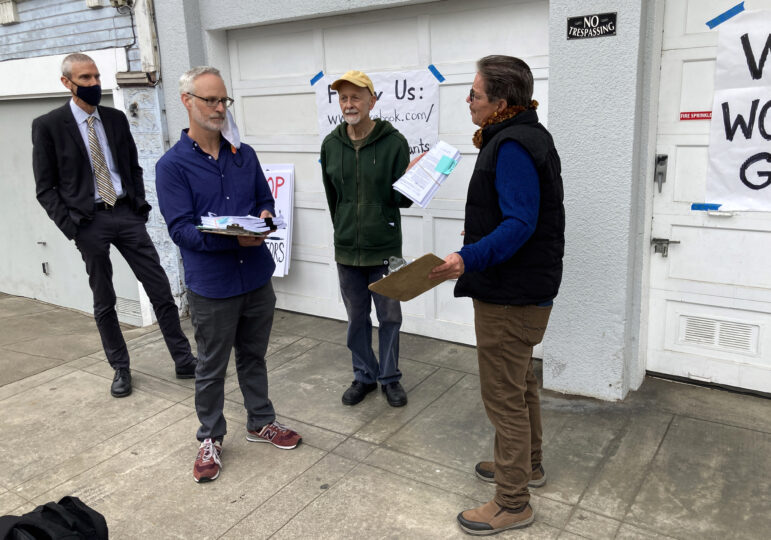
Amplified chants and drumming broke the weekday calm on 19th Street near Dolores Park in mid-November as residents of a 12-unit building protested their impending eviction.  

“Here in this building, six out of the 10 units that are occupied have LGBTQ tenants, five out of the 10 have Asian Americans. And we have seniors in this building who have been here for decades. And we’re all getting evicted,” said Paul Mooney, a gay man who has lived in the building for 18 years and came to San Francisco because of its LGBTQ community.  

Tenants, advocates and city legislators are worried about real estate investors buying multi-unit housing properties like this one only to evict all of the tenants and sell the buildings for a profit. They have called for an end to the state law that makes this possible, the Ellis Act, under which the tenants on 19th Street are being evicted. In the meantime, they want the city and the nonprofits it works with to buy those buildings instead of leaving them for speculators to snap up.   

“The Ellis Act is devastating neighborhoods like ours, communities like ours,” Mooney said. “There’s 20 of us that are at risk of losing our home from this neighborhood that we’ve lived in for so long. And it’s happening all over the city, because of the Ellis Act.” 

But the state Legislature is unlikely to repeal the Ellis Act, one local legislator acknowledged.  

“I think everybody here wants to see the Ellis Act repealed. And we all know that real estate and real estate money has tremendous power and influence in Sacramento,” said District 8 Supervisor Rafael Mandelman at the demonstration.  

In the meantime, however, local government can step in. Last week, the Board of Supervisors voted to allocate $64 million of revenue brought in by the 2020 real estate transfer tax measure Proposition I to an emergency fund for housing acquisition. Supervisor Dean Preston, who proposed the allocation, said there are signs that speculation is threatening many apartment buildings in the city, and that the allocation could help combat that. 

“Preliminary analysis of market trends shows exactly what we fear: A repeat of trends we saw a decade ago,” Preston told the board. “Of 117 buildings between three and 50 units on the private market, 99 of the sellers are individual or families with no connections to big real estate, in contrast to the folks who are lining up to buy these buildings.” 

He said members of the city’s Housing Stability Fund Oversight Committee have been keeping a close eye on the buyers of multiunit properties that go on the market and finding that many are limited liability corporations linked to large corporate real estate investment companies. 

A program called the Small Sites Acquisition Program already exists. Nonprofit landlords and the city collaborate to acquire housing, keep the tenants in place and keep rents below market rate. The city also has the Community Right to Purchase Act, which gives nonprofit organizations the right to make offers on buildings with three or more housing units, or lots that could accommodate such units, before other buyers.       

Some of the supervisors expressed concern that the Small Sites Program is not ready for an acquisition spree and needs serious reform.  

“Promising folks that we’re going to save them from eviction because we’re putting money into this program that is not currently viable, to me is an empty promise,” said Supervisor Myrna Melgar. While she supports funding the acquisition of apartment buildings, she said, “It is like putting gas in a car that has two flat tires and is in the shop getting fixed, and promising people a ride.” 

Most of the acquisitions executed so far through the program have been made by one nonprofit that is overextended and has taken on excessive financial risk, she said. Other supervisors criticized the program for not preserving enough housing. Since the program was launched in 2014, it has acquired 368 units across 47 buildings. 

Mayor London Breed also voiced opposition to the allocation, announcing in a press release that her office would be taking steps to reform the Small Sites Program and allocating up to $10 million from the city’s general fund through June 2022. While the supervisors ultimately voted 8-3 to allocate the $64 million to allow the city to buy housing through any of its acquisition programs, the mayor is not obligated to spend that money and several supervisors expressed doubt that she would. The mayor’s press office did not respond to a request for comment on her intentions. 

Preston, for his part, is optimistic.  

“These funds are going to be appropriated, they’re going to be available,” he said. And the investment is a significant one in terms of how many people could remain housed if their buildings are acquired by a nonprofit.  

“We are looking at hundreds of units,” he said. “It will depend on the exact purchase price of each of those, and the size of the different buildings. But it’ll be hundreds of units and at least double or triple that in amount of people protected.” 


A process server delivers the court documents to Paul Mooney initiating his and other tenants’ eviction under the Ellis Act from a 12-unit building on 19th Street. 

(The above is a segment from SF Public Press's radio show and podcast, “Civic.” Listen daily at 8 a.m. and 6 p.m. on 102.5 FM in San Francisco, and subscribe on Apple, Google, Spotify or Stitcher.) 


Monday, December 13, 2021

Project Open Hand Food Available

Megan Sue Belafonte and Project Open Hand (POH) are giving away food boxes that they receive on Mon. and Fri. mornings at the corner of Folsom and 22nd St. You need to get in line by 10am to get a ticket for a box of food. Then at 11am you may pick up your box. This is a POH program and there is usually milk, two types of protein, lots of vegetables, rice, beans and sometimes even eggs.


POH usually do not do this on days like holidays or the Friday after a holiday (such as Thanksgiving). Sometimes they skip a week so it's best you check with them to see when their next food giveaway is. (415) 447-2300 and https://www.openhand.org/

If you or someone you know can use this service, please do let people know. Please also share this since this catastrophic rise in inflation is crippling people's ability to buy basic food.


Tuesday, December 7, 2021

Should California have a $18 minimum wage? Voters may get to decide

Featured in the LA Times:


California voters could get to decide whether the state minimum wage goes up to $18 an hour, at a time when rising prices and living costs are eating into workers’ household incomes.

Joe Sanberg, a Los Angeles investor and anti-poverty activist, spearheaded the Living Wage Act of 2022, which was filed with the state attorney general’s office Friday. Sanberg said he will finance the signature-gathering process to qualify the ballot initiative for the November election. It would gradually increase the state minimum wage starting in 2023, then rise to $18 an hour for all-sized businesses by 2026.

The current minimum wage is due to reach $15 an hour for large businesses starting in January, and for all businesses by 2023. The state minimum is now $14 an hour for businesses with 26 or more employees and $13 an hour for smaller businesses.

“If you work full time, you should be able to live with full financial security, and that’s not the case in California,” Sanberg said in an interview. “We were a leader in pushing for a $15 minimum wage, but now we have to move the ball forward and farther. It’s overdue for $18.”

He said the time is right to push for a higher minimum wage because the pandemic highlighted how many Californians working full-time jobs still cannot afford basic needs.

Sanberg made his fortune on Wall Street and then shifted to investing in start-ups, including meal-prep company Blue Apron.

He is well-known in Sacramento, having cajoled legislators beginning in 2015 to create a California version of the earned income tax credit — a program that has been expanded in recent years to help more low-income residents. He founded a nonprofit to launch an advertising campaign to make sure eligible people got their money.

He’s also a co-founder of Aspiration, an online banking service that allows customers to choose their own fees.

Although it’s rare for wealthy Californians to personally bankroll all costs involved in an initiative signature campaign, it has happened occasionally through the years.

And under state election law, Sanberg could stop there — choosing to withdraw his proposal once it qualifies for the ballot if lawmakers and Gov. Gavin Newsom agree next year to pass a similar law on their own.

The initiative would mandate that base pay at businesses with 26 or more employees go up a dollar each year until it reaches $18 an hour in 2025. Smaller businesses with 25 or fewer employees will have an extra year to reach the $18 minimum.

After reaching $18 an hour, the minimum wage will be adjusted yearly to keep pace with the cost of living, according to the initiative.

California’s current gradual rise to $15 an hour was the result of a bill signed in 2016 by then-California Gov. Jerry Brown. The law, which went into effect in 2017, raised the minimum wage steadily each year to reach $15 an hour. In 2016, the minimum wage for all businesses was $10.

The rise to a $15 hourly wage has had a “real, measurable effect on workers’ pay in the state,” said Ken Jacobs, chair of the UC Berkeley Labor Center. The center has estimated that 5.6 million Californians would receive a wage increase because of the move to $15 an hour, with an average annual earnings increase per person of $3,700.

By the time the minimum wage reaches $15 an hour, it will equal a total of more than $20 billion a year in wage increases, which is more than the combined value of all the state’s major public assistance programs, Jacobs said.

Still, “it was still an important increase but ... costs have continued to rise,” he said. “It’s also important to note that, especially with rising housing costs in California, that in our major cities, $15 is still not enough.”

Advocacy group United Ways of California calculated that a family of four — two adults, one preschooler and one school-aged child — living in Los Angeles County would need to make an annual income of $95,112 to meet basic needs. That calculation, known as the Real Cost Measure, is based on publicly available data on expenses such as housing, food, healthcare and child care.

California’s high cost of living is a main reason why Sanberg and others are advocating for an $18 an hour minimum wage.

The minimum wage should now be $24, if it increased in line with the growth in worker productivity since 1960, Sanberg said.

The fact that the state base pay is one year away from $15 an hour “doesn’t mean it’s the right minimum wage,” he said. “The job will be done when everyone who works full time can afford life’s basic needs.”

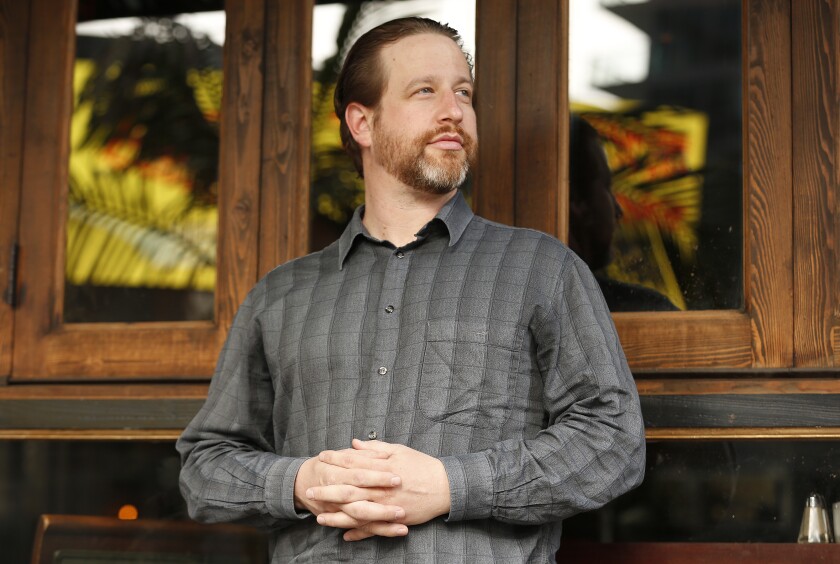
A man in a black striped shirt stands in front of a doorway. 

Joe Sanberg, a millionaire investor and anti-poverty activist, is financing the signature-gathering process for a ballot measure to raise California’s minimum wage. (Al Seib / Los Angeles Times)